Therpa
Unbroken clinical continuity.
A medical-imaging AI platform developed by Husk Labs. Unifying digital radiography, volumetric CT, high-field MRI, and point-of-care ultrasound to address diagnostic blind spots across the complete musculoskeletal care pathway.
The fracture is visible. The blind spot is what causes complications.
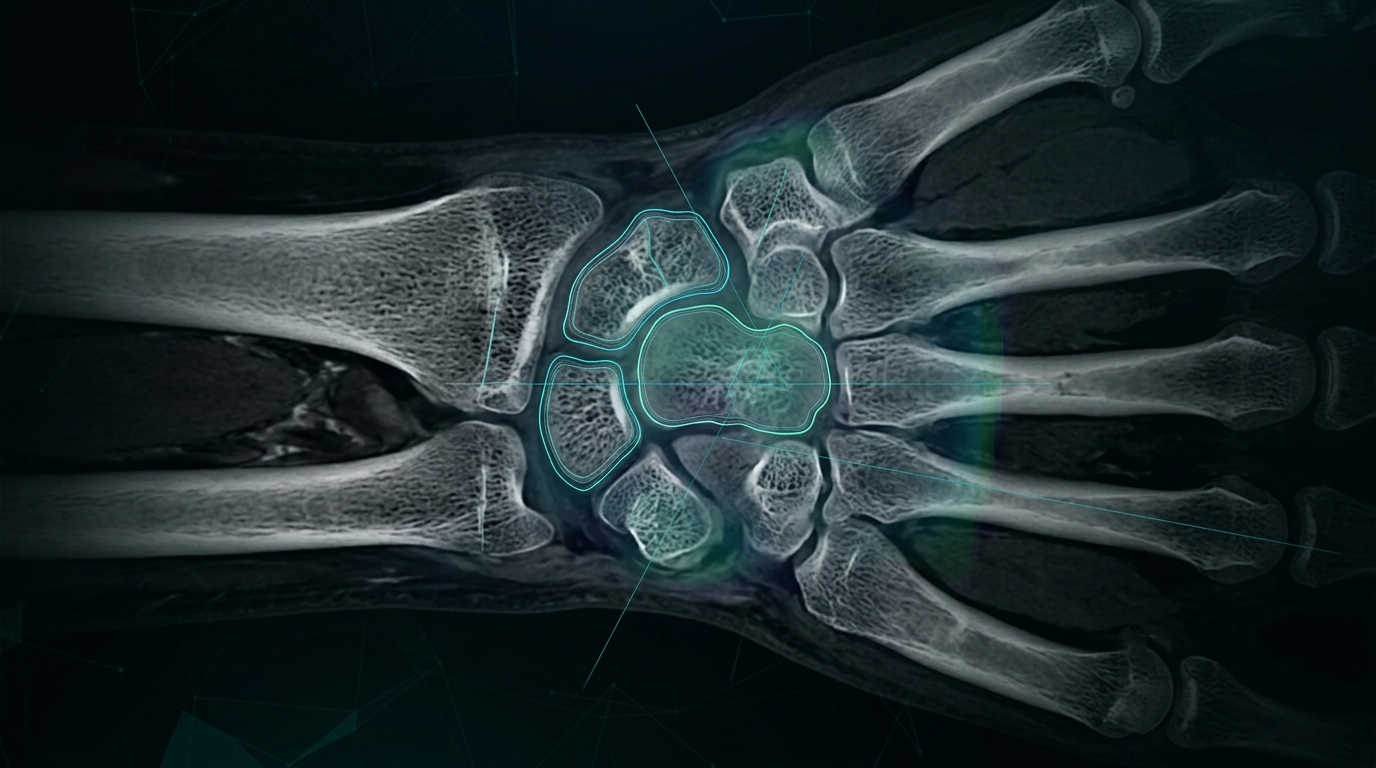
Musculoskeletal imaging has historically been approached through disconnected point solutions. Algorithms that detect obvious fractures on a plain radiograph, but offer no continuity when trauma requires CT for 3D surgical templating, or high-field MRI to evaluate intrinsic ligament disruption.
Therpa operates on vertical clinical depth over commodity breadth. By engineering a unified intelligence layer across all four diagnostic modalities for the wrist, we establish unbroken diagnostic and anatomical continuity from acute emergency triage to outpatient recovery.
“In musculoskeletal trauma, diagnostic failure rarely stems from missing an obvious fracture. It happens in the blind spots between modalities and departments.”
The Therpa Clinical Thesis
Four imaging modalities. One unified intelligence layer.
Explore acquisition parameters, diagnostic capabilities, and radiologic blind spots addressed across each modality.
Unbroken continuity across the patient journey.
From initial trauma intake in the emergency bay through surgical reconstruction and outpatient recovery, Therpa delivers aligned diagnostic intelligence across clinical transitions.
Acute Triage & Detection
Digital Radiography (XR)
Rapidly screens 2D views for occult scaphoid fractures and biomechanical carpal arc malalignment during the initial emergency intake.
Preoperative Surgical Planning
Volumetric CT (3D CT)
Segments comminuted articular fragments and generates virtual contralateral reduction models to inform surgical approach and implant selection.
Soft-Tissue Assessment
High-Field MRI (3.0T)
Evaluates stabilizing intrinsic ligaments and TFCC fibrocartilage tears to determine conservative management versus surgical intervention.
Bedside & Longitudinal Care
Point-of-Care Ultrasound (POCUS)
Provides dynamic bedside nerve tracking and synovitis monitoring across serial visits to evaluate functional recovery and response to therapy.
Engineered for high-assurance clinical environments.
Hospital systems and clinical researchers demand strict data boundaries. Therpa is engineered to operate natively within institutional privacy and infrastructure standards.
Zero PHI Egress
On-premise and dedicated private-cloud deployment models ensure patient identifiers, study keys, and protected health information never leave your institutional firewall.
Native DICOM Interoperability
Compatible with standard DICOM C-STORE and C-MOVE interfaces, enabling direct integration with hospital PACS and VNA archives without requiring third-party portal logins.
Transparent Quantitative Outputs
Analytical findings produce structured DICOM SR outputs and reproducible metric overlays, providing clear, explainable evidence that supports clinician review.
Partner with us on the future of clinical imaging.
Therpa represents Husk Labs' commitment to developing proprietary deep-tech platforms that solve complex challenges. While our initial focus is the intricate biomechanics of the wrist, our core segmentation and morphometry architectures are designed to expand to adjacent joints.
Clinical & Academic Research
We collaborate with academic medical centers, orthopedic departments, and clinical researchers on retrospective validation studies and multi-modality research.
Strategic & Health System Partners
Explore early-access demonstration sessions, technical evaluation frameworks, and integration roadmaps with our engineering leadership.